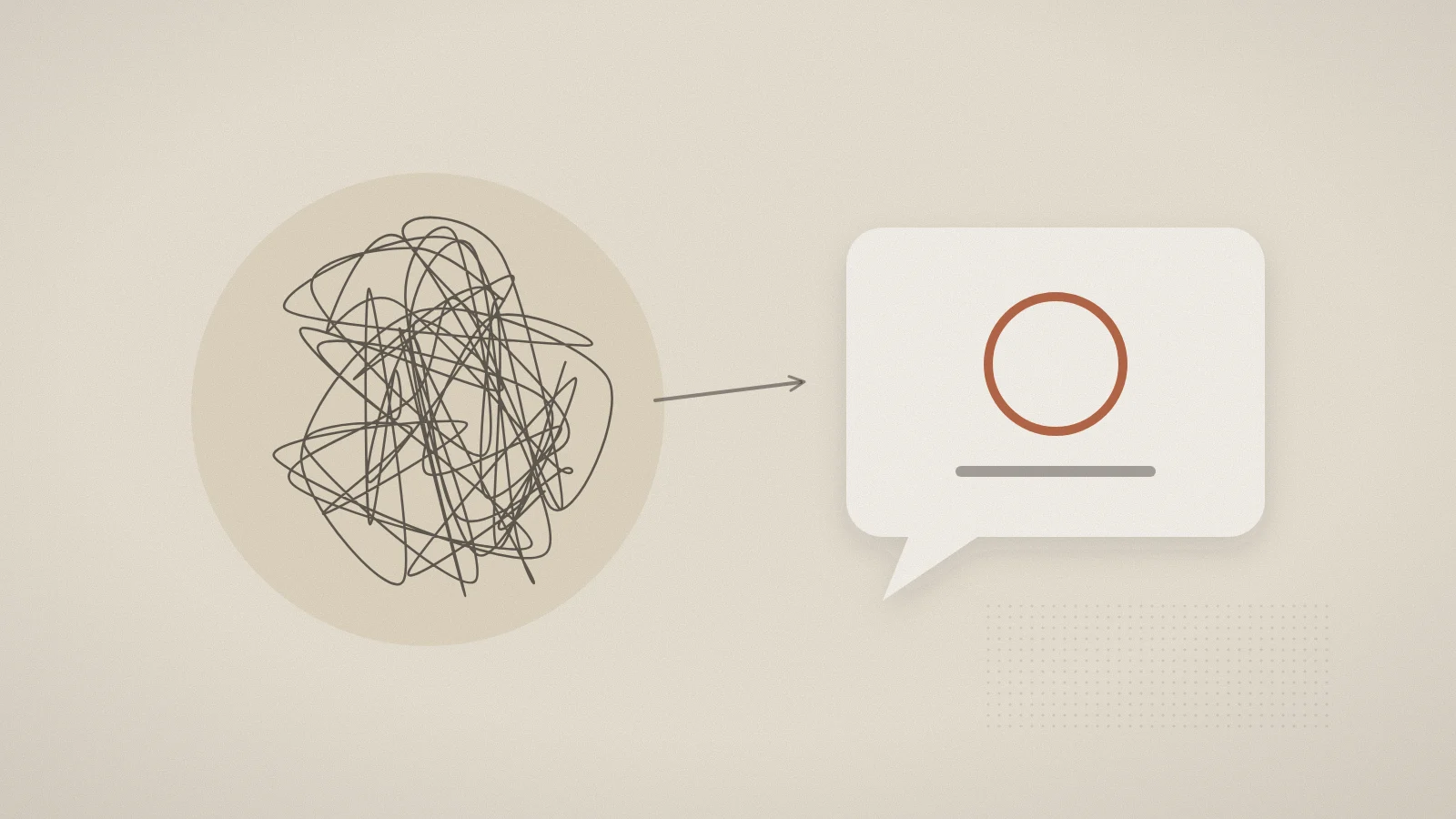
The physicist Richard Feynman was famous for explaining hard ideas in plain language - and for being suspicious of anyone, himself included, who could only explain something in jargon. The "Feynman technique" is a modern study method named in his spirit. He never wrote it down as a four-step recipe, but the idea at its core is his: if you can't explain something simply, you don't understand it yet.
The method is useful because it attacks the most dangerous state a student can be in: feeling like you understand something you don't.
Why explaining works
Re-reading your notes tells you whether the material looks familiar. Explaining it tells you whether you can rebuild it - and the gap between those two is often enormous.
Research backs this up from a few angles:
- Self-explanation. In a 1994 study by Chi and colleagues, students who were prompted to explain a biology text to themselves as they read it understood it more deeply than students who read it twice.
- Learning by teaching. Students who learn something expecting to teach it organize the material better and recall more of it (Nestojko and colleagues, 2014). Actually explaining it to someone afterwards helps further.
Explaining is a form of retrieval - you pull the idea out of memory and reorganize it - which is why it shares the benefits of practice testing. (More on that in why re-reading fails.)
The four steps
1. Pick one concept and write it at the top of a page
One concept, not a chapter: "standard deviation," "opportunity cost," "how a bill becomes law." Narrow is better.
2. Explain it as if to a smart twelve-year-old
Write or say out loud an explanation that someone with no background could follow. No jargon unless you define it. Use an example.
This is harder than it sounds. You'll find yourself reaching for the textbook's phrasing - that's the signal you've hit the edge of your understanding.
3. Find the gaps, then go back to the source
Read your explanation back and look for:
- Jargon you didn't define - you're hiding behind a word.
- Jumps - "and so…" where you can't say why it follows.
- Hand-waving words - "basically," "sort of," "it just does."
- No example - if you can't produce one, you probably can't apply the idea yet.
Each gap is a precise to-do item. Go back to your notes, the textbook, or the lecture for that specific point, not the whole chapter.
4. Simplify, and try again
Rewrite the explanation with the gaps filled, shorter than before. Look for an analogy that captures the structure of the idea. When you can explain it cleanly from memory, you're done - for now.
A worked example: standard deviation
First attempt:
Standard deviation is the square root of the variance, which measures dispersion of the data around the mean.
That's a correct definition and almost no understanding. "Variance" and "dispersion" are doing all the work, and there's no example.
After two rounds:
Standard deviation tells you roughly how far, on average, the numbers in a list are from their average. Two classes can both average 70% on a test. If almost everyone in the first class scored between 65 and 75, its standard deviation is small. If the second class has lots of 40s and lots of 100s, its standard deviation is large. It's a measure of how spread out the results are - not of how high they are.
The second version would survive a follow-up question. The first wouldn't.
Making it a habit
You don't need to do this for everything. Use it where it pays:
- After a lecture, on the one idea you found hardest. (It pairs well with the cue column in Cornell-style notes.)
- Before an exam, on topics where you know the definitions but haven't been tested on applying them.
- When a practice question surprises you, on the concept behind it.
And use a real listener when you can. A classmate's confused face finds gaps faster than you will on your own.
Using an AI tutor as the listener
When nobody's around, an AI tutor can stand in for the listener - if you use it to check your thinking rather than to do it for you. Write your explanation first, then ask the tutor to point out what's missing or wrong, or to ask you the follow-up question a skeptical classmate would.
In Skolight, the AI tutor answers from your own course material and cites the passages it draws on, so when it flags a gap you can check the claim against your notes instead of taking it on trust. We wrote more about the difference between using AI to think and using it to avoid thinking in how to study with AI without outsourcing your thinking.
The short version
- One concept, at the top of a page.
- Explain it simply, with an example.
- Find the jargon, jumps, and hand-waving; go back to the source for those.
- Simplify and repeat until it's clean.
The explanation you can give from memory is the understanding you'll have in the exam.