Students tend to have strong feelings about mind maps. Some swear by them; others find them a pretty way to waste an afternoon. Both camps are partly right, because outlines and maps are good at different things. The useful question isn't which one is better - it's which one this topic needs.
What each format is good at
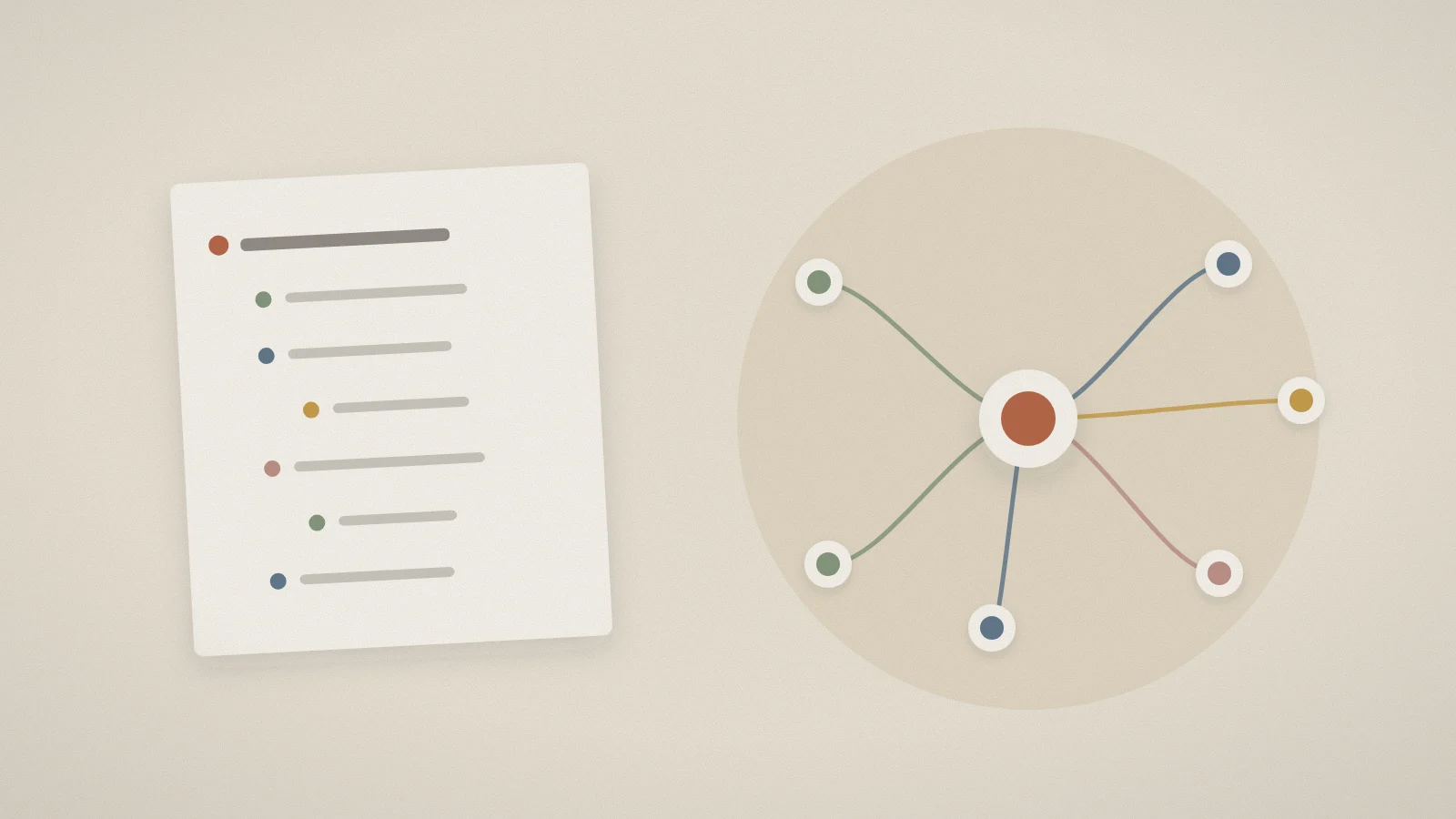
An outline is a hierarchy written top to bottom: headings, sub-points, sub-sub-points. It's excellent at:
- Order - sequences, processes, arguments that build step by step.
- Hierarchy - what's a main idea and what's a detail.
- Density - it fits a lot of information on a page.
A mind map puts the topic in the center and branches outward. It's excellent at:
- The big picture - the whole topic visible at once.
- Connections - how branches relate to each other, not only to their parent.
- Starting points - brainstorming, or getting oriented in an unfamiliar topic.
A useful rule of thumb: if the material has a natural order (the stages of mitosis, the plot of a novel, the steps of a proof), outline it. If it has a natural web (causes of a war, factors in a business decision, a body system), map it.
What the research says - and doesn't
The strongest evidence isn't about mind maps in their popular, free-form style. It's about concept maps, developed by Joseph Novak in the 1970s, where every link between two ideas is labeled with the relationship ("causes," "is a type of," "requires").
A 2006 meta-analysis by Nesbit and Adesope pulled together dozens of studies and found that studying and building concept maps was associated with modestly better learning than reading text or lists, across many subjects. Modest is the important word: maps aren't magic, and a beautiful map you've copied from someone else is mostly decoration.
The common thread across the research is that the benefit comes from the thinking you do to build the structure - deciding what's central, what connects to what, and how. That's true for outlines too.
How to use maps so they actually teach you something
Build it yourself (or at least rebuild it)
The learning is in the construction. If you start from a generated or borrowed map, treat it as a draft: reorganize branches, rename nodes in your own words, delete what doesn't matter.
Label the links
Borrow the best idea from concept maps. Instead of a bare line from "Insulin" to "Blood glucose," write "lowers" on it. Labeled links force you to state the relationship - which is exactly what exam questions test.
Redraw it from memory
The most powerful use of a mind map is the second one. A few days after making it, take a blank page and redraw the main branches without looking. Then compare. Whatever you missed is your revision list. This is retrieval practice wearing different clothes - the same principle behind testing yourself instead of re-reading.
Convert between formats
Turning an outline into a map (or the reverse) is a great comprehension check. To map an outline, you have to find connections across sections. To outline a map, you have to decide on an order. Both are thinking you can't fake.
When to use which, in practice
| Situation | Use | Why |
|---|---|---|
| Getting oriented in a new topic | Mind map | See the whole shape before the details |
| Taking notes in a lecture | Outline (or Cornell notes) | Lectures arrive in order, and you need speed |
| Reviewing a topic before an exam | Mind map, redrawn from memory | Tests whether you can see the whole thing |
| Planning an essay | Map first, then outline | Ideas first, then an argument with an order |
| Learning a process or proof | Outline | Order is the content |
Making the first draft faster
Drawing a map of a 60-page chapter by hand is slow, and most of that time goes into layout rather than thinking. A reasonable shortcut is to generate a draft and spend your time on the parts that teach: reorganizing, labeling, and redrawing.
Skolight's mind map generator turns a chapter, lecture, or set of notes into an editable map you can expand, collapse, and rearrange, then export as an image or PDF. Use it as the draft - and then close it and redraw the main branches from memory. That second map is the one that tells you what you know.
The short version
- Order-shaped material → outline. Web-shaped material → map.
- Build or rebuild the structure yourself; that's where the learning is.
- Label your links with the relationship.
- Redraw from memory to find your gaps.
The format matters less than the thinking it makes you do.