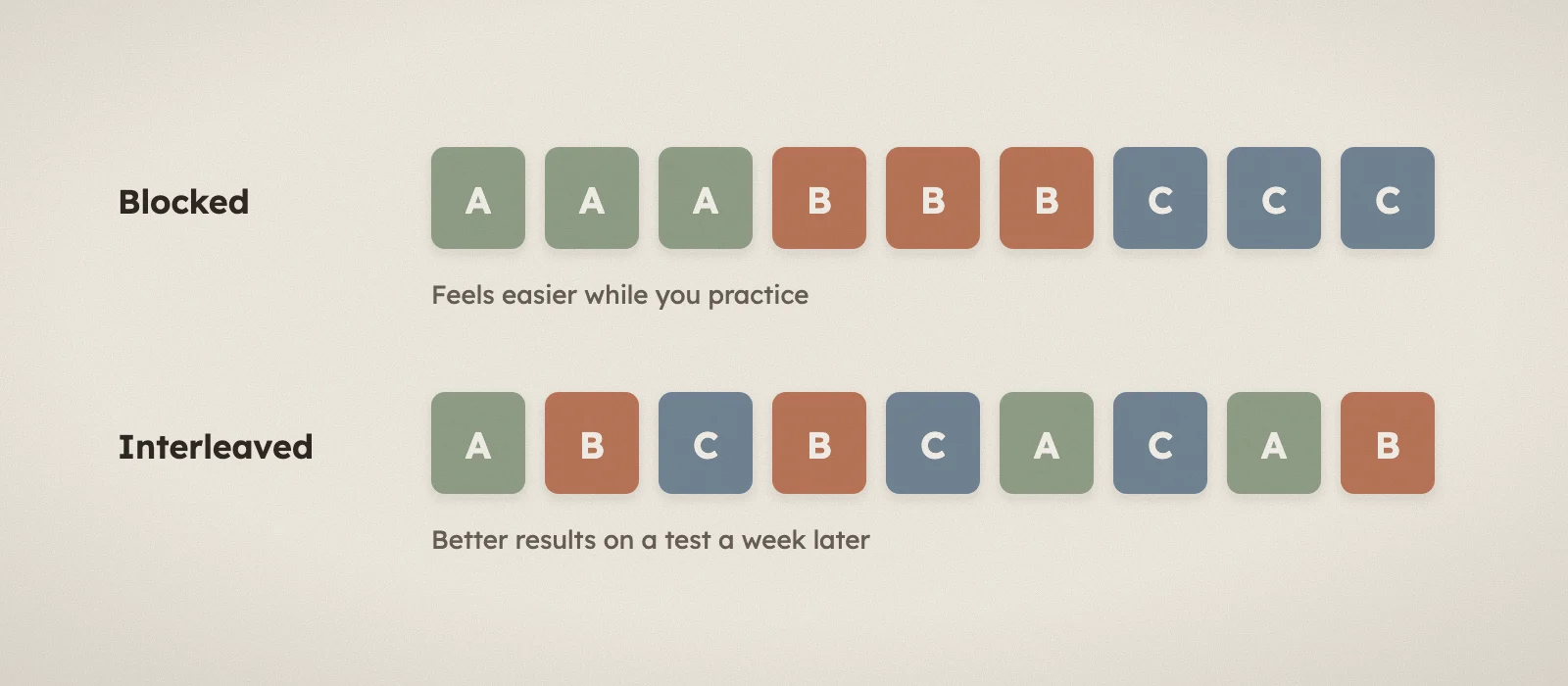
Most practice is organized in blocks. You learn the volume of a cone, then do twenty cone problems. Then cylinders, twenty cylinder problems. Then spheres. By the end of each block you're fast and accurate, and it feels like learning.
Then the exam mixes them all up, and suddenly the hard part isn't solving the problem - it's working out which kind of problem it is. Block practice never trained that.
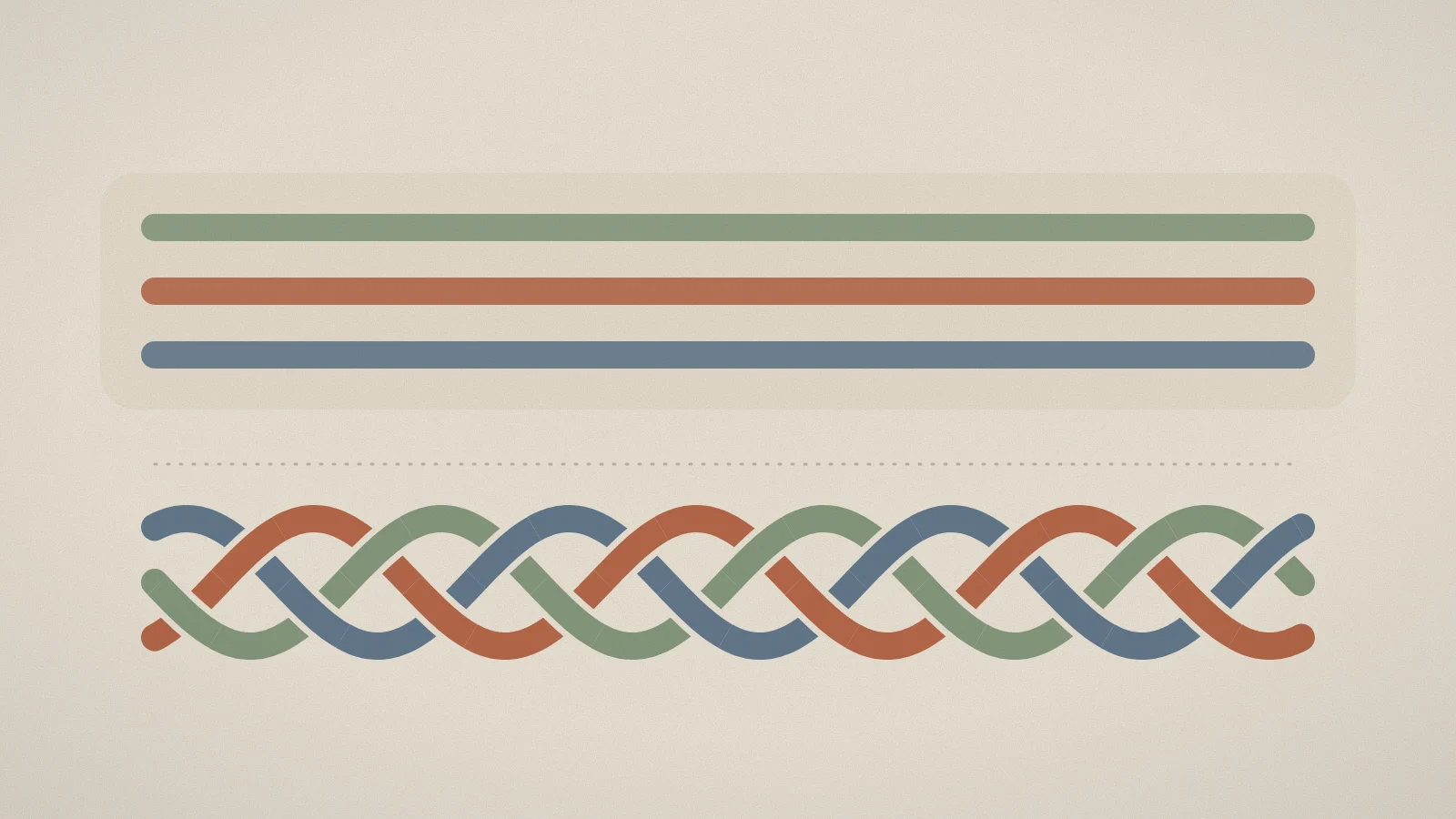
Interleaving means mixing different topics or problem types within one practice session. It's one of the more counterintuitive findings in learning science: it feels worse while you're doing it, and it works better afterwards.
The evidence
Two studies are worth knowing:
- Maths problems. In a 2007 study by Rohrer and Taylor, students practiced finding the volumes of different geometric solids, either in blocks or mixed together. During practice, the blocked group did better. On a test a week later, the interleaved group scored roughly three times higher - about 63% versus 20%.
- Recognizing styles. In a 2008 study by Kornell and Bjork, people learned to recognize paintings by different artists, either one artist at a time or mixed. The mixed group was better at identifying new paintings by the same artists - yet most participants believed afterwards that blocking had helped them at least as much.
That second result is the key to the whole idea. Interleaving doesn't feel like it's working. Your sense of fluency during practice is a poor guide to what you'll remember later.
A 2019 meta-analysis by Brunmair and Richter, pooling dozens of studies, found the benefit is real but not universal: it's strongest for maths and for learning to tell similar categories apart, and weaker - occasionally absent - for simple word lists. So it's a tool for the right job, not a rule for everything.
Why it works
Two things happen when topics are mixed:
- You practice choosing the strategy, not just executing it. In a block, you know every question is about cones. Mixed, you have to look at each problem and decide what it is - which is exactly what an exam asks.
- You notice the differences between similar ideas. Seeing mitosis and meiosis questions side by side makes their differences stand out. Seeing them a week apart lets them blur together.
There's also a quiet spacing benefit: when topics are interleaved, each one comes back after a gap, so you get some of the effect of spaced repetition for free.
How to interleave without making a mess
Interleaving works best with a few guardrails:
- Learn first, mix second. When a topic is brand new, a short block of focused practice helps you get the basic method. Start mixing once you can do the problems at all.
- Mix related topics. Interleave things that could be confused - types of integrals, similar historical periods, related drug classes. Mixing biology with French vocabulary doesn't help much; the topics never compete.
- Mix old with new. Each practice session can include a few questions from earlier weeks. This doubles as revision and stops older topics fading.
- Expect lower scores in practice. That's the "desirable difficulty" doing its job. Judge the method by your test results, not by how smooth practice feels.
Practical ways to do it
You don't need special materials. A few easy options:
- Shuffle textbook problems. Instead of doing 1–20 in section 4.2, do five from 4.1, five from 4.2, and five from 4.3, in random order.
- Mix flashcard decks. Review several related decks together instead of one at a time.
- Write mixed practice tests. When you turn lecture slides into a practice test, pull questions from two or three lectures and shuffle them.
- Plan mixed sessions in revision. In the last weeks before an exam, most sessions should be mixed. (We built this into our example in how to make a study plan by working backward.)
If you make practice quizzes in Skolight, you can do the same thing by choosing several sources at once - say, three weeks of lecture slides - when you generate a quiz with the quiz generator. The questions then draw on all of them, so you practice the mix instead of one chapter at a time.
The one-sentence version
Once you can do each type of problem on its own, stop practicing them one at a time: mix them up, accept that practice feels harder, and let the test results tell you it worked.