Spaced repetition is one of the best-supported ideas in learning science. But it has a weak point that no algorithm can fix: the cards themselves. A badly written card gets reviewed on a perfect schedule and still doesn't stick - or worse, it "sticks" as a string of words you can recite without understanding.
Most of what makes a flashcard work was written down in 1999 by Piotr Wozniak, the researcher behind SuperMemo, in an essay called Twenty Rules of Formulating Knowledge. Here are the nine that matter most for students, with examples.
1. Understand it before you memorize it
A flashcard is a tool for keeping knowledge, not for acquiring it. If you make cards from a chapter you haven't understood, you'll memorize sentences, not ideas - and the cards will be painful to review because nothing connects them.
Read, take notes, and make sure you could explain the topic roughly before you write a single card. (The Feynman technique is a quick way to check.)
2. One fact per card
This is Wozniak's minimum information principle, and it's the rule most students break. A card that asks for five things will be marked "wrong" whenever you miss one, so you'll keep reviewing all five - including the four you already know.
Too big:
Q: What are the stages of cellular respiration and where does each happen?
Better:
Q: Where in the cell does glycolysis happen?
A: The cytoplasm.Q: Where does the Krebs cycle happen?
A: The mitochondrial matrix.
More cards, but each one is fast, unambiguous, and reviewed only as often as it needs.
3. Make the question impossible to misread
If you ever find yourself thinking "oh, that's what it was asking," the card is ambiguous. Add just enough context to point at one answer:
- Vague: "What does insulin do?"
- Precise: "What does insulin do to blood glucose levels?"
4. Use cloze deletions for facts that live in a sentence
A cloze card blanks out one part of a sentence:
The Krebs cycle releases ____ molecules of CO₂ per turn.
Cloze cards are quick to make from your notes and keep the fact in its natural context. Just keep the blank to one idea - rule 2 still applies.
5. Avoid lists - or break them into overlapping cards
"List the seven characteristics of living things" is a terrible card. You'll get it partly wrong forever. If you genuinely need a list, split it up:
- Use cloze cards that blank out one item at a time.
- Or ask about each item's role: "Which characteristic of life describes maintaining a stable internal environment?"
6. Ask "why" and "how", not only "what"
Cards don't have to be definitions. Some of the most useful ones test reasoning:
Q: Why does a skewed dataset make the median a better summary than the mean?
A: The mean is pulled toward extreme values; the median isn't.
A handful of "why" cards per topic keeps your deck from becoming a vocabulary list.
7. Add a cue when two cards interfere
Similar cards confuse each other - mitosis and meiosis, two economists with similar theories, two vocabulary words that look alike. When you notice yourself mixing them up, make the difference explicit: add a short cue ("meiosis - produces gametes") or write a card that asks for the difference directly.
8. Personalize with your own examples
A card linked to something you already know is easier to recall. "Opportunity cost: the hour you spent in this lecture could have earned $15 at work" will outlast a textbook definition, because it's attached to your life.
9. Delete or rewrite cards you keep failing
If a card has failed four or five times, the card is probably the problem, not you. It's usually too big (rule 2), ambiguous (rule 3), or about something you never understood (rule 1). Rewrite it, split it, or delete it. A smaller deck you trust beats a large deck you dread.
Then: review on a schedule
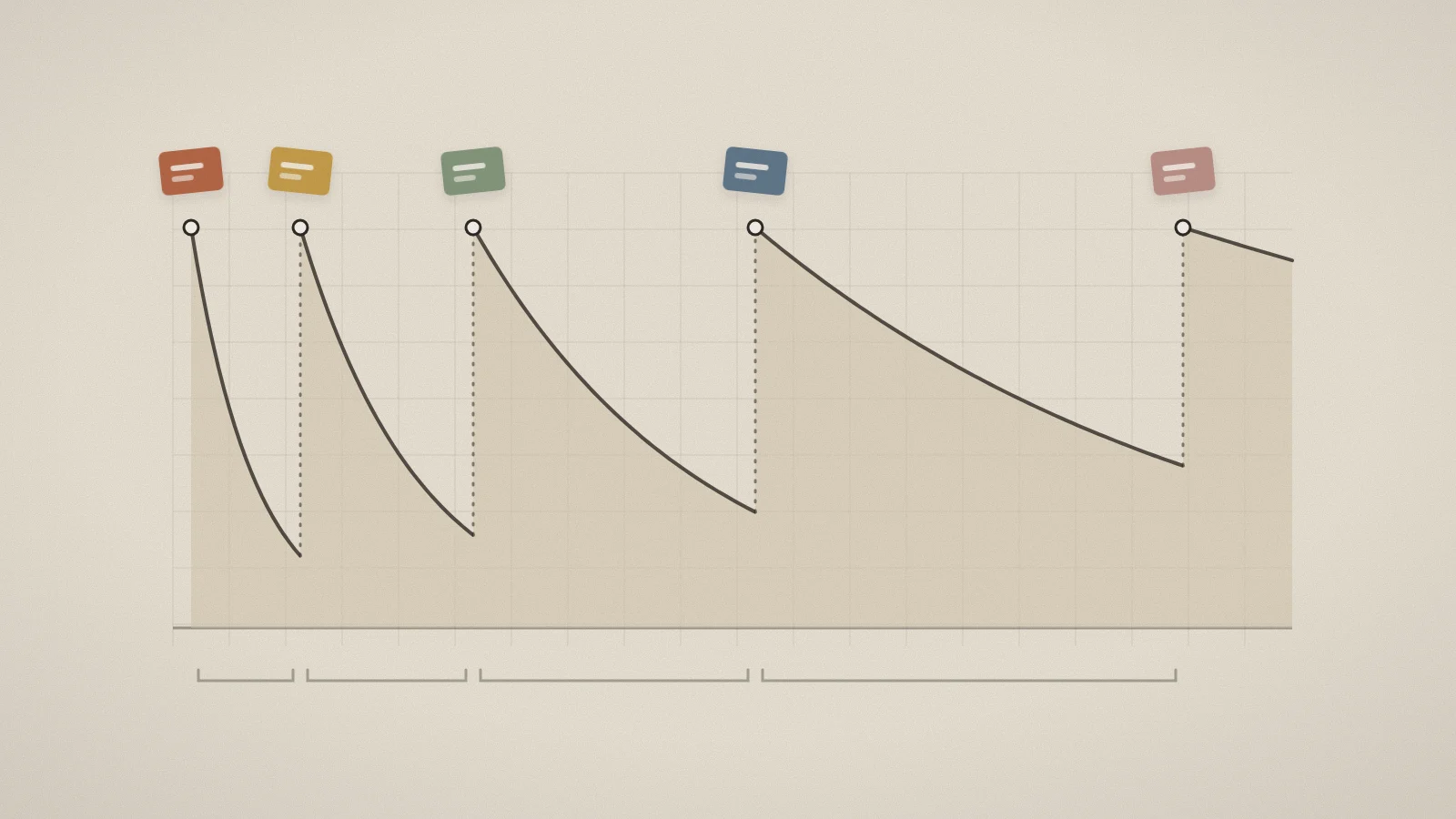
Good cards are half the system. The other half is reviewing them just as you're about to forget - a little each day rather than all at once. We covered how that works in our guide to spaced repetition.
Writing the first draft faster
Writing cards by hand is genuinely useful - deciding what deserves a card is a form of studying. It's also slow, and it's the step where most decks die. A reasonable middle ground is to generate a first draft and spend your time editing instead of typing.
That's how Skolight's flashcard generator is meant to be used: it drafts a deck from your lecture slides or notes, and you rewrite, split, or delete cards using the rules above before you start reviewing. The edit pass is where the learning happens; the typing isn't.
The short version
- Understand first.
- One fact per card.
- One possible answer.
- Cloze for facts in sentences.
- No lists.
- Include "why" cards.
- Add cues to separate look-alikes.
- Use your own examples.
- Fix or delete cards you keep failing.
Write fewer, smaller, clearer cards - and the schedule will do the rest.